
Understand the DTV Before You Apply.
Understanding DTV visa requirements is an important
first step before preparing your application.
The Destination Thailand Visa (DTV) is a Thai visa
category for eligible foreigners under specified
purposes, including workcation, Thai soft
power-related activities, and spouses and
dependent children of DTV holders.
This guide explains the DTV, its eligibility
categories, key visa conditions, supporting
documents, and application process based on
information published by Thai authorities.
The Destination Thailand Visa (DTV) is a Thai visa category designed for eligible foreigners who wish to enter Thailand for qualifying workcation purposes, certain Thai soft power-related activities, or as a spouse or dependent child of a DTV holder.
The DTV has a 5-year validity and allows multiple entries, with a stay of up to 180 days per entry, subject to the applicable rules.
The DTV is designed around different reasons for spending extended periods in Thailand. Your application pathway and supporting documents therefore depend on why you are applying and your individual circumstances.
Valid for 5 years from the date of issuance.
Multiple entries are allowed during the visa validity.
Up to 180 days per entry, subject to applicable rules.
The DTV covers several qualifying purposes and applicant groups.

For eligible applicants whose purpose is connected to workcation.
The DTV also covers eligible participants in qualifying activities such as:
The DTV also covers qualifying family members of DTV holders.
Applicants must provide evidence supporting their qualifying purpose or family relationship. The applicable supporting document depends on the pathway and individual circumstances.
The required documents depend on the purpose of the DTV application and the requirements applicable to the application.
Under the latest supporting-document adjustment announced by Thailand's Department of Consular Affairs, applicants should note two important changes.
The previous “Document indicating current location” has been replaced by:
Applicants must also provide:
These changes apply to DTV applications submitted from 31 August 2026 at 00:00 hrs. Thailand local time onward, according to the announcement reflected in the current DTV guide.
A valid passport or travel document.
A recent photograph meeting the applicable requirements.
The latest DTV document adjustment replaces the previous document indicating current location with proof of permanent residence.
Official DTV information identifies financial evidence of at least 500,000 THB as a requirement.
The exact form, period covered, currency, certification, or additional financial evidence may depend on the applicable application requirements.
A certificate of criminal record clearance is now an additional supporting document under the latest DTV adjustment.
Additional documents are required according to the purpose of the DTV application.
Not every DTV applicant submits the same supporting
documents.
Your documents should demonstrate
why you are applying under the relevant DTV pathway.
Applicants may need documents demonstrating their professional status, such as:
The exact documents requested can vary according to the applicable application requirements.
Applicants may need:
The supporting evidence depends on the activity.
Applicants may need documents establishing the qualifying family relationship, such as:
The applicable documents should be checked against the requirements for the specific application.
The published DTV framework identifies
at least 500,000 THB
in financial evidence.
Depending on the application requirements,
examples of financial evidence may include
bank statements, payslips, and sponsorship evidence.
Minimum Financial Evidence
Identified in the published DTV framework.
The period covered by bank statements
Currency
Certification
Account ownership
Supporting financial documents or additional evidence
For this reason, applicants should check the requirements of the Thai mission responsible for their application before submitting.
The Workcation category is intended for eligible:
Digital Nomads · Remote Workers · Foreign Talent · Freelancers
The important question is not simply whether you work online.
You need to be able to demonstrate the
professional basis for your application.
Depending on the applicable requirements, supporting evidence may include documents that demonstrate your professional status.
Depending on the applicable requirements, supporting evidence may include:
Employment contract
Employment certificate
Professional portfolio
Evidence should support the purpose of your application.
The exact documents requested can vary according to the applicable application requirements.
Different professional situations can require
different evidence.
An employee, freelancer, business owner,
and other types of remote professional may not
have the same documents available.
That is why your application should be prepared
around your actual situation,
rather than simply following a generic checklist.
The DTV also covers eligible activities connected
with Thailand's culture, training, and related purposes.
Applicants need supporting evidence demonstrating
their participation in the relevant activity.
For medical treatment, this may include an appointment
letter from a hospital or medical centre.
Examples identified by Thai authorities include:
Muay Thai
Thai cooking
Sport training
Medical treatment
Seminars
Music festivals
Applicants need supporting evidence demonstrating
their participation in the relevant activity.
For medical treatment, this may include an appointment
letter from a hospital or medical centre.
The evidence should connect clearly to the activity selected.
The supporting evidence depends on the specific Soft Power-related activity.
The document requirements are not necessarily
identical across different Soft Power activities.
The evidence should clearly support the
activity selected for the application.
Spouses and dependent children
under 20 years old
of DTV holders may apply under the relevant
DTV category.
Applicants need documentation establishing
the qualifying relationship.
Examples include:
Marriage certificate
Birth certificate
Certificate of adoption
The supporting documentation should establish the qualifying relationship between the applicant and the DTV holder.
The applicable documents should be checked against the requirements for the specific application.
A DTV application involves more than collecting documents from a checklist. Potential preparation issues can arise when:
Professional evidence does not clearly support your stated purpose
Financial documents do not meet the applicable requirements
Supporting documents are incomplete
Documents do not clearly establish the relationship or activity claimed
Different documents provide inconsistent information
You are relying on an outdated checklist
Requirements applied by the relevant Thai mission differ from what you expected
This does not mean that every application with an issue will be rejected. It means that preparation matters.
Before submitting, you should understand what your documents demonstrate, whether they support the purpose of your application, and whether they meet the current requirements applicable to your case.
Before spending time preparing every document, start by understanding your situation.
Start Your DTV Assessment →Free to start · No payment required · No obligation
The DTV is valid for 5 years from the date of issuance.
The visa allows multiple entries during its validity period.
The DTV permits a stay of up to 180 days per entry.
Official DTV information states that a holder may apply for a one-time extension per entry for a period not exceeding 180 days through the Thai Immigration Bureau, subject to the applicable rules.
After the maximum permitted stay under that entry, the applicable immigration rules require departure from Thailand before making another entry using the valid DTV.
Visa validity and permitted stay are different concepts. A 5-year visa does not mean you can remain in Thailand continuously for five years without following the applicable entry and stay conditions.
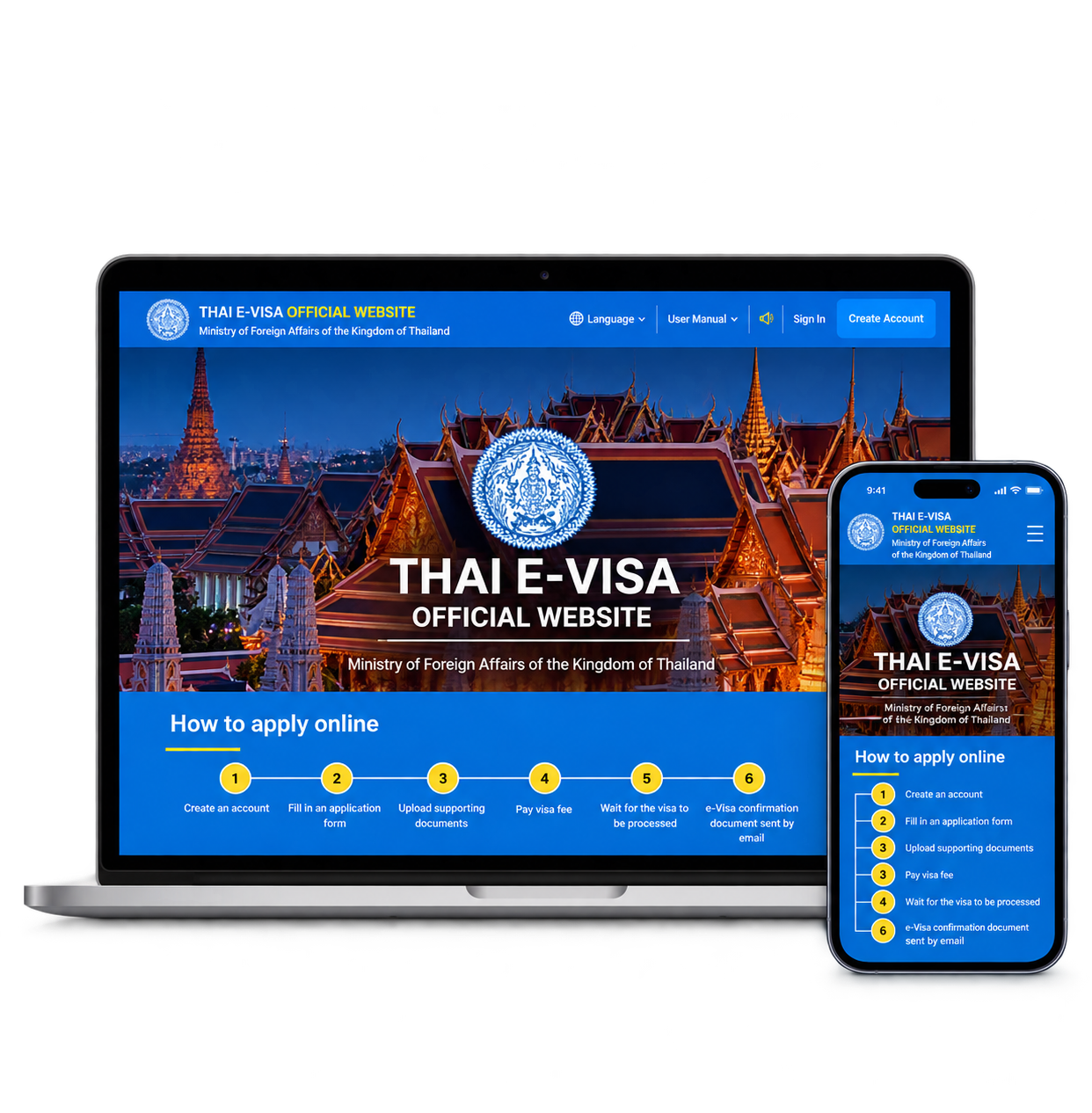
The official Thailand e-Visa system provides online visa applications for eligible applicants.
Applicants should identify the Thai diplomatic mission responsible for their application and check its current requirements before submitting.
Visa fees, supporting documents, document formats and other application requirements can vary according to the responsible Thai mission.
Do not assume that a checklist from one embassy or consulate automatically applies to another.
The official Thai e-Visa system provides an online application process.
Create an account on the official Thai e-Visa platform.
Select the appropriate visa category and complete the application information.
Upload the documents required for your application.
Pay the applicable visa application fee through the system.
The application is reviewed by the relevant authority.
Once approved, the e-Visa confirmation is sent electronically.
Submission of an application does not itself guarantee approval. The relevant Thai authority may request additional documents or information where applicable.
The government visa fee is separate from any professional service fee.
The applicable visa fee can depend on the Thai diplomatic mission and the currency in which the application is submitted.
Mileprowise does not present one universal THB government fee as though it applies to every applicant. Before applying, check the current fee published by the Thai mission responsible for your application.
Government visa fees are paid according to the applicable official process and are separate from Mileprowise service fees.
Thailand has different visa and long-stay pathways, and the DTV is not automatically the best option for every person.
The DTV is particularly relevant to eligible applicants under Workcation, Thai soft power-related activities, and qualifying spouse/dependent-child purposes.
The Destination Thailand Visa is a Thai visa category for eligible foreigners under Workcation, Thai soft power-related activities, and qualifying spouse/dependent-child purposes.
The DTV has a 5-year validity and allows multiple entries.
The DTV permits a stay of up to 180 days per entry.
A one-time extension of up to 180 days per entry may be available through the Thai Immigration Bureau, subject to the applicable rules.
Official DTV information specifies financial evidence of at least 500,000 THB. The exact supporting evidence and requirements should be checked with the relevant Thai mission.
Yes. Under the DTV supporting-document adjustment announced in August 2026, a Certificate of criminal record clearance was added as a supporting document for applications submitted from 31 August 2026 onward.
The latest adjustment replaces “Document indicating current location” with “Proof of permanent residence.”
Freelancers are included in the Workcation category identified in official DTV information. Applicants still need to provide appropriate evidence supporting their professional basis for the application.
Spouses and dependent children under 20 years old of DTV holders are included in the relevant DTV category, subject to the applicable requirements.
The official Thai e-Visa system provides online applications for the DTV. Applicants should check the current eligibility and application requirements applicable to their situation.
Foreign nationals who are permitted to stay in Thailand for more than 90 days are generally required to notify Thai Immigration of their residence every 90 days under the applicable immigration rules.
This requirement is separate from the DTV's visa validity and entry conditions.
If you leave Thailand and return, the 90-day period is generally counted from your latest arrival date.
DTV holders should check the current requirements and available reporting methods with Thai Immigration.
No.
You can complete the assessment while you are still planning your move to Thailand or preparing your documents.
Starting earlier gives you more time to understand your preparation needs and address areas that may require attention.
Yes.
The DTV Readiness Assessment is free to complete. You do not need to purchase a service package before completing the assessment or receiving your Personalized Assessment.
The assessment typically takes 10–20 minutes, depending on your situation.
You can save your progress and return later if you need more time.
You will receive an initial result.
Mileprowise then reviews the information you provide and prepares a Personalized Assessment based on your individual situation.
Your Personalized Assessment is provided within 24 hours under the current workflow.
You can review the assessment and decide whether you would like to continue with Mileprowise.
Official information explains the visa requirements.
But understanding the rules is only the first step.
How those requirements apply in practice depends on your professional background, intended purpose, financial situation, supporting documents and personal circumstances. That is where Mileprowise starts.
Our DTV Readiness Assessment helps you understand where you stand before you decide how to proceed.
Free to start · No payment required · No obligation
DTV requirements can look straightforward on paper, but how they apply in practice depends on your circumstances. If you have a question about your situation, you can talk to Mileprowise before you start preparing.
Talk to Mileprowise →We use cookies to help our website work properly, understand how visitors use it, and improve your experience. You can choose which cookies to allow.